
Union County Court Records After Arrest
After a Union County arrest, the jail side and the court side do not mean the same thing. Booking is the law-enforcement process. It can include identity checks, a custody entry, arrest charges, fingerprints, and a photograph when one is taken and releasable. A court record begins when a complaint, information, indictment, ticket, or other filing opens a case in the First Judicial Circuit for Union County. That court record is where the filed charge, case number, hearing schedule, warrant entries, release terms, disposition, and sentence history are tracked.
The State's Attorney decides which formal charges to pursue, subject to the law and facts. The Union County State's Attorney is Tyler Tripp, and the First Judicial Circuit lists the office at the Union County Courthouse in Jonesboro. For custody and booking details, use Union County jail inmate records. For booking photos, use Union County jail mugshots. For certified copies, older files, sealed cases, or docket questions, the Circuit Clerk is the proper court office.
Find Union County Court Records
Judici's Union County case search is the located online portal for Union County court records after a jail arrest. Judici is useful for a first public lookup, but it is a vendor portal. The page itself states that Judici operates the service and that links do not mean court endorsement of Judici content, policies, or services. The public search is not the same as a certified clerk copy.
The best search starts with the arrest date, arresting agency, and full legal name. If the person was just booked, call the Union County Sheriff's Office first because the court record may not exist yet. Once a case is filed, search by defendant name or case number, then compare the case location, filing date, offense date, and charge details before treating the result as the right person.
| Field Label | Type | Required | Union County Search Notes |
|---|---|---|---|
| Court | fixed court selection | yes | Use the Union County, IL Judici court page with court code IL091015J. |
| Case Number | text | optional | Use when a ticket, complaint, warrant, or court notice already gives a number. |
| Litigant or Party Name | text | optional | Use the defendant's legal name when the case number is not known. |
| Date Range or Filing Date | date filter | varies | Narrow the search when the interface exposes date filters. |
| Case Type | filter | varies | Narrow to criminal or traffic where available. |
| Subscriber Services | login path | no | Paid or attorney tools may differ from ordinary public summaries. |
The Judici Union County search screen is the practical first stop after filing.
The search screen supports the core task here: finding the filed court case, not proving where the person is housed today.
Union County Arrest Charges Filed
A deputy or police officer may list an arrest charge based on probable cause at the time of booking. The prosecutor can then file the same charge, add counts, decline counts, reduce counts, or proceed through a different document. That is why Union County court records after arrest should be read as the filed case record, not as a copy of the jail booking screen.
Three charging documents can matter in a Union County criminal case. The names are technical, but the difference is simple: each is a way to put a criminal accusation into the court file. The document type can affect how the docket looks and whether later entries replace or supersede the earliest arrest charge.
| Document | What It Is | What To Check |
|---|---|---|
| Complaint | An initial written charge often used early in a case. | Compare the offense date and count list to the arrest facts. |
| Information | A formal prosecutor-filed charge, often used when a felony proceeds without a grand-jury indictment. | Check whether it amends or replaces an earlier complaint. |
| Indictment | A grand-jury charging document. | Look for added, changed, or superseding counts in the docket. |
Union County Charge Status Records
Charge status is the part of the Union County court record that says where each count stands. A single arrest can lead to more than one count, and each count can move in a different way. One count may be dismissed while another remains pending. A charge may also be amended or reduced before a plea, trial, supervision order, or sentence.
| Status | Plain Meaning | Why It Matters After Arrest |
|---|---|---|
| Pending | The charge has been filed and has not been resolved. | The case is still active, and future hearings or release terms may appear. |
| Amended | The original charge has been changed. | The court record may no longer match the first booking charge. |
| Reduced | The filed offense has changed to a lower charge. | The disposition should be read by count, not by the arrest label alone. |
| Dismissed | That count ended without a conviction on the count. | Other counts may still remain open or have separate outcomes. |
| Nolle prosequi | The prosecutor declined to proceed on the charge. | This is a prosecution entry, not a jail release record. |
| Supervision | An Illinois disposition that may avoid conviction if completed. | It can still appear while active and should not be called a conviction without checking the final result. |
| Warrant or FTA | A failure-to-appear or warrant entry. | It can explain a new booking even when the old case began earlier. |
Note: When a case has several counts, read the status line for each count instead of relying on the first charge shown.
Union County Court Contact Routing
The First Judicial Circuit Union County directory is the main local court contact source. It lists Circuit Clerk Keri E. Clark at 309 W Market St., Room 108, Jonesboro, IL 62952, phone 618.833.5913, and State's Attorney Tyler Tripp at the courthouse, phone 618.833.7216. It also lists judges, public defenders, and probation contacts. Those offices serve different parts of the post-arrest process.
The First Judicial Circuit directory shows the local court offices that handle Union County court records after arrest.
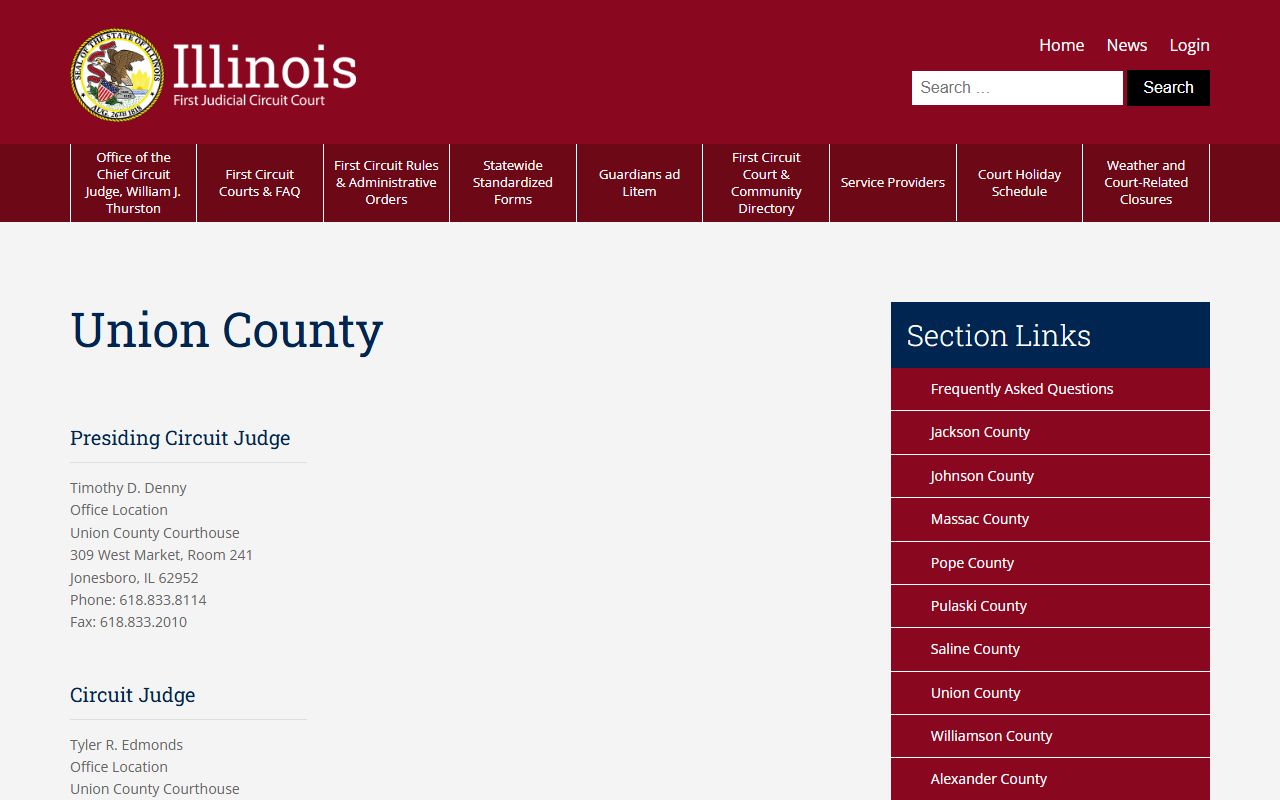
The directory helps route a question to the clerk, prosecutor, public defender, or probation office rather than treating all court questions as jail questions.
| Office | Use For | Do Not Use For |
|---|---|---|
| Circuit Clerk, Keri E. Clark | Case numbers, public summaries, certified copies, court dates, and clerk payments. | Real-time custody, medical, or jail visitation questions. |
| State's Attorney, Tyler Tripp | Prosecutor-filed charges, victim and witness routing, and prosecution status when public. | Defense advice or inmate lookup. |
| Judge Offices | Court administration and courtroom matters through proper channels. | Public custody checks or informal case advice. |
| Public Defenders | Representation questions for eligible defendants. | Public background checks or records requests. |
| Probation | Supervision after a court order or probation case status where appropriate. | New booking confirmation. |
| Sheriff's Office | Current custody, booking, arrest records, transfer location, and jail status. | Certified court copies. |
Pretrial Release After Arrest
Illinois no longer works like a traditional commercial bail-bond state for new criminal cases. Union County release after arrest is controlled by the court's pretrial release or detention decision, any court-ordered conditions, and any active hold from another agency. The Sheriff's Office can confirm whether a person is still in custody, but the formal case path and court dates belong with the Circuit Court and Circuit Clerk.
| Term | Current Illinois Meaning | Union County Lookup Path |
|---|---|---|
| Pretrial release | Release before trial with conditions set by the court. | Check Judici or the Circuit Clerk after filing. |
| Detention | Court-ordered custody before trial when legal criteria are met. | Confirm custody with the sheriff and court status with the clerk. |
| Recognizance | Release based on a promise to appear and follow conditions. | Read the release entry and next court date. |
| Cash bond | A historic or legacy term that should not be assumed for a new case. | Call the clerk before paying or relying on old bond language. |
| Surety bond | Illinois does not operate like commercial bail-bondsman states for new release decisions. | Do not route Union County release questions first to a bondsman. |
| Hold or detainer | Another agency's hold can block release even if the local case allows it. | Ask the sheriff what agency controls the hold. |
Union County Warrant Arrest Records
No official Union County sheriff warrant-search database or active-warrant list was located in the official-source research. A warrant can still lead to booking through the Sheriff's Office or another holding facility. Judici may show failure-to-appear, bond, warrant, or hearing entries once the matter is part of a court case, but it may not say where the person is housed.
Do not try to clear a warrant by relying on a web search alone. A warrant can result in immediate arrest. Contact the Circuit Clerk, an attorney, or the court to learn whether an appearance, recall, release condition, or other order is required. For custody after a warrant arrest, call the Union County Sheriff's Office at 618-833-5500 and verify any transfer location.
Charges and Convictions Compared
Being arrested, being charged, and being convicted are separate events. A Union County court record after arrest may show a filed accusation before the case has been proved. A conviction requires a plea, finding, or verdict. Public readers should avoid treating an open charge, dismissed count, or supervision entry as the same thing as a conviction.
| Point | Charge | Conviction |
|---|---|---|
| Stage | An accusation filed in court. | A final adjudicated outcome or plea on a count. |
| Proof | May begin from probable cause and prosecutor filing. | Requires a guilty plea, finding, or verdict under the criminal process. |
| Record Meaning | Shows what was alleged and how the case moved. | Shows the resolved legal outcome for that count. |
| Common Error | Calling every filed charge a conviction. | Ignoring dismissed or amended counts when reading a case. |
Sealed and Expunged Arrest Records
Illinois law allows some records to be sealed or expunged through the legal process. 20 ILCS 2630/5.2 governs expungement, sealing, and immediate sealing of eligible Illinois records. Eligibility depends on the case result, offense type, prior history, timing, and court order. It is not automatic just because a person was arrested in Union County.
| Point | Sealed | Expunged |
|---|---|---|
| Public Access | Hidden from most public access after the court grants sealing. | Removed or treated as erased under the expungement order. |
| Record Existence | The record still exists with limited lawful access. | The record is cleared under the legal effect of the order. |
| Who Decides | The court, after a proper petition or authorized process. | The court, after a proper petition or authorized process. |
| Best Contact | Circuit Clerk, attorney, or court self-help resources. | Circuit Clerk, attorney, or court self-help resources. |
Note: A sealed or expunged case may not appear in a public portal even though nonpublic legal records still exist for limited uses.
Restricted Court Records After Arrest
Illinois FOIA treats specified arrest-report information as public, but it also allows exemptions and redactions. 5 ILCS 140/2.15 covers arrest-report information, including timing and custody details. 5 ILCS 140/7 covers exemptions that may protect investigations, safety, security, juvenile information, and records restricted by other laws. Court access has its own limits for sealed, expunged, juvenile, and otherwise restricted matters.
Important: Public case lookup is not a consumer report and must not be used for employment, housing, credit, insurance, or another FCRA-covered decision.